The changing landscape of digital marketing

In the world of Internet technology, change continues to happen at lightning pace and with it, consumer habits are changing just as quickly. Digital marketers must keep up or risk getting left behind by others who adapt more quickly. To keep the right messages in front of the right audiences via the right media, digital marketers need to not just to stay current, but to stay ahead of evolving consumer trends.

Everything mobile: Move quickly. According to Google, typical Americans check their phones 150 times a day. Each mobile session lasts only about 70 seconds, but that adds up to almost 3 hours in one day. To reach consumers, your message must be where they are and when they are there. Websites and advertisements designed for mobile must render well on a wide variety of screen sizes, and they must load quickly. Google refers to “I-want-to-know, I-want-to-go, I-want-to-buy and I-want-to-do” moments – moments when consumers see something that sparks their interest and leads to a related quick internet search. With a strong digital marketing campaign, your message can reach those consumers when they get an impulse to know something, go somewhere, buy something or do something. This is also referred to as In The Moment Marketing. It’s about advertising to the right consumers in the right place at the right time, all the time.

Social media: Reputation is everything. The average person in North America spends more than four hours a day on social media. While the social media experience is divided among a large and growing number of platforms and apps, the division provides an opportunity for digital marketers. Social media advertising lets companies target narrowly defined audiences, both by choosing a platform popular to a specific demography and by narrowing ad buys to specific subsets of those users based on lifestyle, life stage, interests, hobbies, affiliations with groups, and many other selections that allow for micro targeting to highly productive groups of consumers. Deeply targeted campaigns can be a game-changer for social advertising performance.

Video: Roll the tapes! Consumers increasingly are turning to short videos instead of pages and pages of text. According to Zenithmedia Bluecorona, video is expected to make up 82 percent of all internet traffic in 2021. Already, video is winning more screen time than static content. From a digital marketer’s perspective, where there is video, there is video advertising. Think of video advertising as a TV commercial, only much better. Video ads are far more targetable, more affordable, more measurable and offer direct response capabilities which makes this platform far, far more productive than TV. Being a Google owned company, the targeting capabilities on YouTube are mind-blowing and if done right, YouTube ads can perform exceptionally well.

Content is king: The more things change, they more they stay the same. While consumer trends and digital marketing opportunities are changing rapidly, at least one thing has held constant. To catch and hold consumers’ attention, marketing messages still must have strong, clearly communicated, relevant content. The three benefits of good content are: 1) Illustrate your expertise and leadership in your industry, 1) keep your company and products or services top of mind among your customers and clients and 3) being an important SEO tactic, good, relevant content improves your natural rank in the search engines.

It can be hard to keep up with the rapidly changing trends and tactics in digital marketing. If you’d like a helping hand, we’re here for you. If you’d like to chat about a specific challenge you’re having or goal you’re trying to hit, feel free to reach us at (203) 682-4585. You can also schedule some time for a chat here, or visit www.adedgemarketing.com. We’d love to share both ideas and cold, hard data about the latest digital marketing tactics that perform best for your industry.

Finding the right fit: pros and cons of working with a large or small digital marketing agency

Looking for a digital marketing partner? Or any other business service provider, for that matter? If so, there are many important factors to consider in making your decision. For example, the services offered and price points are obviously important but there are many others to consider. For example, how well does the firm “fit-in” with your organization? This is based mainly on how well you expect your teams to work together.

One important factor that you many not have considered is size. Do you want to work wtih a large company or small? There are various pros and cons. Bigger companies may have more resources, more people and — in some cases — more experience… at least they pay this a lot of lip service. But smaller companies can also have advantages, especially for small to mid-sized organizations.

Response time. In many cases, smaller companies can respond and move more quickly. Do you have a question or suggestion about your marketing campaign? Do you want to make a small — or not so small — change to an existing program or start something new? At a small agency, you can call your account rep and make it happen! With fewer organizational layers, small agencies are more nimble and it takes them less time to start or update a campaign or a marketing effort. On the other hand, this could be a case where experience is helpful. You want a company than can move quickly, but you also want to work with people who know whether your suggestion is a good idea. If it is, they need to know how to make it happen and if it isn’t, you need to be able to rely on them for pushback.

Customization. You’re looking for digital marketing expertise, but in what area? Do you need search engine optimization or social media management? Or both? Make sure the company you’re working with can provide what you’re looking for. Larger companies may have more experience in a variety of services and options but they tend to package and manage services in more of a cookie-cutter, automated way. Smaller agencies tend to be able to design a marketing campaign custom-built for specific industries, clients and goals. They tend to address the specific needs of small to mid-size companies rather than using a one-size-fits-all approach.

Focus. You want to know your service provider is working for you. There are many ways that can play out. With a larger company, you might have several people working for you and often times, floating account reps who may not be familiar with your campaign, other than what they read in their CRM notes. With a smaller agency, you are likely to receive more personalized attention. Smaller companies tend to have fewer clients, so they can provide more personalized attention to you, and they tend to care more about the relationship.

Overhead. Bigger firms may have more resources, but sometimes that can get expensive and cumbersome. Smaller companies have fewer employees, fewer organizational layers, lower rent (or no rent) and therefore can operate with more cost-efficiency and speed.

Whether you work with a large agency, a smaller agency or something in between, it’s important to do your homework. Find an organization that works well with you and your needs. If you think AdEdge may be the right size firm to serve your digital marketing agency needs, give us a call. We’d love to set you up with a free consultation to see how we could work together. You can reach us at (203) 682-4585, schedule some time for a chat, or visit www.adedgemarketing.com.


Building a strong reputation is essential

Building a strong reputation is essential

Do you have a great product or a great service? That’s wonderful. But it’s not enough. Do your customers know your products and services are great? More and more, people only will buy — and sometimes even shop — from highly rated companies and organizations with good reputations. A recent survey of online shoppers showed that 78% of people say it is very important to look up a business online before deciding to interact or do business with them. A study by the Etail Group shows that 92% of users read internet reviews, and a Cone Inc. shows that 89% of users trust online reviews. So positive reviews and a good reputation are critical and they can have a significant impact on your Search Engine Marketing efforts (including Paid Search and SEO). How?

Put simply, when customers search for something online, they are looking for the best solution to their issue. Sounds obvious but let’s think about two key words here: “best” and “solution” and what they mean. Most prospects start by searching for a solution. That also happens to be where most marketers doing Search Engine Marketing focus all their attention. They ask, “What words will prospects search for when they are in need of the products or services we sell?” It’s a fair enough question but whether it’s spelled out in a search query or not, most consumers are performing a two-part search. Part one is the outward question that presents itself as a search query, “Who has what I need?” but the second question that often goes unstated but is equally important is, “Who’s got the best of what I need or who will best solve my problem?” This is where reputation in the form of reviews and ratings is critical… your reputation is usually sitting right there at the top of the screen or within one click. In most industries, people choose to work with the best. Is your online reputation better than your competition? Will prospective customers and clients choose you over other options they see on the Search Engine Results Page? If not, how do you build a reputation for your company that will have you shining above your competition and will make you the most attractive choice?

Reputation management essentially is managing how people perceive your brand or company. To improve this perception, you need to create strong content and monitor and interact with others regarding conversations about your products and services, and your brand. The following steps can help you to build and maintain a strong reputation:

1. Create positive content. A steady flow of positive pages and search results can help set you apart as an expert and can cover over or reduce the impact of any negative content. One way to achieve this is with a blog. Illustrate your expertise in your field – include interesting and insightful information so people will actually read it.

2. Be meaningful. Be valuable to your readers. Answer their questions (stated or unstated) and give them information that is helpful to them. If you can benefit your readers, they’re more likely to talk about your post and share it with their friends and followers, which will spread your words much farther.

3. Be honest. Honesty can help you build a reputation as an expert. If you get caught in a lie, the hit to your reputation could be severe.

4. Limit the self-promotion. People don’t want to listen to a constant sales pitch. If you provide useful information to your readers, you will promote your broader message and brand. But if you focus only on yourself, you’ll turn away your audience. Keep in mind what’s in it for them. How do people benefit from visiting your site?

5. Be social. While a strong blog can set you as an expert, it’s not helpful if no one sees it. Being active on social media can help build followers and direct traffic to your site. Different social media channels and platforms have different audiences. Know where your audience is and how to interact with them.

6. Respond quickly and often. Social media is supposed to be social. Draw out your readers with questions and challenges. Encourage them to interact, and respond when they do.

7. Give back. When people interact with your blog and social media, post to theirs.

8. Get good pub. Gain publicity by writing articles for other blogs, buying web advertising and looking for other ways to ethically promote your brand or company as much as possible.

9. Respond properly to negative reviews. If you catch and address negative reviews quickly, you are much more likely to convince the reviewer to provide a better review. If the reviewer is unwilling to change the review, you may be able to post information that addresses, corrects or provides additional information about the negative post. But don’t get into a fight with people looking to cause trouble. And don’t make personal attacks.

10. Encourage reviews. Since you’re looking to improve your reputation, make sure to ask only happy customers to rate you and leave you a review. Don’t ask all customers to post reviews and don’t make the mistake of publishing links to your Google page or Yelp for this purpose. Doing so invites reviews from both happy and unhappy customers, and possibly even competitors. A good online reputation builder service will do all the hard work for you, communicating directly with customers and separating the happy from the not so happy. Happy customers are encouraged to leave reviews and unhappy customers get a feedback form that goes to their account manager or service department. A good reputation builder program can improve your online reputation quickly.

If you want to generate business from your Search Engine Marketing effort (whether paid or organic), make sure to 1) Show up in the Search Engine Results Page when prospects search for the products or services you sell and 2) have a great reputation in the form of positive reviews and ratings that illustrate you clearly as the best choice. If you have any questions about your online reputation or need some words of advice, feel free to give us a call at 203-836-8390 or shoot us a note.  All AdEdge clients get our Reputation Builder service free of charge for six months. If you’re not a client, feel free to schedule a 15-minute demo of our affordable and highly effective AdEdge Reputation Builder service. And do sign up for our newsletter to get monthly digital marketing tips delivered straight to your inbox.

Raise the banner

If you’re looking to gain awareness of your brand or direct potential customers to your website, banner advertising might be what you’re looking for. Banner ads can be designed in various sizes, shapes, and styles and can be designed based on your industry and goals. The versatile banner ad is a utility player, able to handle most situations.
Also known as display advertising, banner ads typically feature a combination of an image and text. They can be static images such as a .jpg or .png file, or they can feature multimedia, such as animated gifs, flash or HTML5 animation. Perhaps overused at the birth of the internet with flashing, eye-numbing animations, effective banner ads today typically are much more subtle, designed to catch viewers’ attention while not distracting them from the advertisement’s message or goal. Finding that balance is sometimes harder than it sounds. How do you do catch a viewer’s attention without being overly distracting or obnoxious? Some banner ads include subtle animation, catching the viewers’ attention and directing them to the text on the ad. Perhaps only a small portion of the ad will be animated. Another strategy is to use color for the same objective. For example, a banner might be black and white, with one accent color designed to direct the reader to the advertisement.
Back in the day, banner ads were targeted by simply choosing websites on which to place the ads. Placement-based banner advertising still works in certain limited cases, depending on the industry. But much more advanced and higher-performing forms of banner ad placement and targeting have evolved. Now, banner ads can be targeted based on search history, website visit history, look-alike audiences, and even by matching to a customer or lead list, called CRM-targeted banner advertising. With demographic targeting, banners can reach prospects by age, gender or income. Geographic targeting can be done by country, state, city, distance from a point, IP targeting and even rooftop targeting for certain industries. Also called geofencing, rooftop targeting works well for certain industries that target specific locations, such as colleges that are targeting “feeder schools”.
Banner ads provide two benefits. Like print ads or billboards, they can promote a brand (company or product), a message or an idea. Viewers see the brand and eventually become comfortable with it. They take in the message and even if they do not interact further with the banner ad, it’s mission is accomplished. But because banner ads also are clickable and interactive, they are a form of digital direct response advertising. This is the second benefit. Clicks on banners direct interested prospects to a landing page that (if designed properly), will engage the visitor and in some cases, convert them to a lead or customer. These forms of engagement and lead generation can include a newsletter signup, download, live or animated chat, the Contact Us page or sales page. We’ll talk more about landing page design in the near future.
Like other online advertisements, banner ad performance is easily measurable. At a very basic level, advertisers can see how many prospects viewed and clicked on each ad and can compare performance between ads and websites that are delivering the best click-through rates. With Google Analytics in place, performance measurement is taken to a different level by crossing over to the website. With analytics, advertisers can tell which clicks are delivering the best value in terms of the amount of time clicks spend on the landing page, how many pages are viewed and whether or not clicks are converting to leads or sales.
Here at AdEdge, we run regular AB and multivariate tests on banner ads for our clients where we are constantly testing for the best performing images, copy, calls to action and depending on the business, offers and premiums. By running banner ads in a “test and control” environment, we are able to prove theories about what is driving ad performance within any given industry. Our unique research also gives us insights about ad format performance. For example, square banners perform better than leader boards and towers on most websites and for most industries. And static ads generally perform better than animated ads, again depending on the campaign goals, industry and demographics we are targeting.
Banner ads can be designed in various sizes and shapes and placed in various places on a website. Regardless of the dimensions or specific design, effective banner ads should include your company logo, name, product or service being offered, a unique selling proposition or value proposition and if the ad is to be dual purpose (branding and direct response), a call to action such as watch now, learn more or get started. The text should be easily readable and have a fair amount of white space to keep it uncluttered and “easy on the eyes”. Google Ads requires banner ad file sizes to be under 150k and in .gif, .png or .jpg formats.
Banner ads are a great way to build your company’s brand and attract visits to your website from good, prospective customers. Is your company using banner advertising to its best potential? If not or if you’re not sure, give us a call at (203) 682-4585 or contact us for a free evaluation and some great ideas. If you enjoyed this blog, sign up for our newsletter and get best practices and new tactics in digital marketing delivered straight to your inbox once a month.

How Keywords Can Make or Break your Paid Search and SEO Efforts

Building a Paid Search campaign with Google Ads (formerly Google AdWords) is easy. Select a few keywords, write an ad, set a budget and whamo, you’re in business, right? It depends. If you want to be in the business of paying Google then yes, you’re in business but if you’re looking to build leads and sales, not so fast. Google makes it very easy for you to build a campaign – and the easiest of all is Google Express. But don’t expect it to perform. Why? The primary reason is poor keyword selection. “Come on, a keyword is a keyword, right?” Wrong. There is far more to keyword research and selection than you might think, especially in a competitive environment.
Identifying keywords to use for a Paid Search campaign starts by thinking about terms your customers will search from their perspective, not yours. Let’s say you sell corporate accounting services. Your top keywords should be corporate accounting services, corporate accounting, accounting for companies and so on, right? Maybe, maybe not. You need to think about this from the customer’s perspective. What are they going to search for? Possibly corporate accounting but consider the myriad other options such as, accounting firms, accounting companies, business accountants, best business accounting firm in Hartford, among others. After doing the research, you’ll often find hundreds of potentially winning combinations of terms used to find a single type of business. A strong effort starts with a core set of terms, adds similar terms and then adds adjectives to modify the base terms. Terms with three or more words are considered “Long Tail Keywords”. Coming up with a good and relevant set of long tail keywords has three benefits: 1) Your competition is less likely to have thought of them making the terms far less costly, 2) long tail keywords are specific and when paired with equally specific ads and landing page within a tightly-themed AdGroup, will perform better for the simple reason that you are presenting an ad and a landing page that answers a specific need or solves a specific problem. 3) Starting with a robust set of keywords gives you more data about which keywords are performing well and which are performing poorly. This allows you to more easily optimize the keywords by adjusting maximum bids at the keyword level based on performance. The two other things to consider when building keywords is Match Type and Negative Terms. Match Type sets the rules under which keywords will trigger your ads to show. Broad Match keywords gives Google carte blanche to modify the term with what they think is a match. Using the example above, Google may substitute jobs for companies which means when someone searches for “accounting jobs” your keyword for “accounting companies” will trigger an ad to show. Google’s logic is that some people searching for accounting companies are actually searching for accounting jobs …but what good does that do you? Long story short, don’t use Broad Match keywords. The opposite problem happens with Exact Match keywords where the exact term needs to be searched with nothing before, after or in-between. The problem with Exact Match is it leaves out plenty of good terms like, “best accounting companies”. Since this does not match exactly with “accounting companies”, your ad will not show. The happy medium is Broad Match Modifier and Phrase Match terms which allow additional terms before, after and in some cases, in the middle of the keyword but will not allow keyword replacements. If you are running either of these match types, Negative Keywords are very important. For example, if you are not a tax accountant, you may want to run a negative term for tax so that when someone searches for “tax accounting companies”, your ad doesn’t show. Other common negatives are free, cheap, jobs, sucks and other non-performing terms. Here at AdEdge we’ve amasses a list of hundreds of negatives terms by reviewing performance of hundreds of clients over our 12 years at this. By limiting irrelevant searches, a robust list of negative terms improves performance a great deal.
The process for selecting keywords for SEO is similar, but not the same. Before embarking on an SEO campaign, we often advise our clients to run a paid search campaign first so that we can see how suspected keywords are performing in their market, in the real world. We look at three things: 1) Search volume, 2) click volume and most importantly, 3) post-click performance. Post click performance is an evaluation of what website visitors did on your website after clicking your ad. How long did they stay on the site, how many pages did they view, which pages did they view, did they engage with the site and did they convert to a lead or sale? By aggregating performance of each keyword over time, we can identify a definitive list of keywords to push for your SEO. But we’re not done just yet. Before committing to these top keywords, we run them through a competitive analysis to see who else is ranking for those terms and how powerful their SEO is. Why? Because we don’t want to fight any big battles that we can’t win. Here’s a super short case study to prove the point. A real estate broker in Manhattan came to us in frustration with their SEO effort that was managed by a previous agency. They paid big money to rank for “NY Real Estate Broker” and other popular, relevant terms that describe their services. Sounds reasonable, right? Unfortunately, their agency failed to complete a competitive analysis that would have shown that page one of Google was crowded with some very big players like Realtor.com, Yelp and Zillow. These companies have very hard-hitting SEO that can be displaced only with a very substantial effort and six-figure+ budget. Instead, we researched our client’s top performing keywords, netted out against highly competitive terms and got them to rank on page one for several excellent keyword terms. The SEO work we did had a significant impact on their rank, website traffic and ultimately, leads.
Here at AdEdge Digital Marketing, we’re all about campaign optimization and performance. If you’re not sure how well your Paid Search or SEO effort is performing (whether it’s being managed internally or through an agency), feel free to contact us for a complimentary evaluation. Contact Anthony at 203-682-4585 or email anthony@adedgemarketing.com.

LinkedIn vs. Facebook

Advertising Battle of the Social Networks:

If you’ve been tracking performance of your social media advertising campaigns or that of your clients, you’ll know that LinkedIn has gotten more expensive in terms of simple cost per click while under-performing other social networks. LinkedIn’s biggest challenge for marketers is it tends to be a place for “Hunting” rather than a network like Facebook which is a site for “Gathering”. In a gathering situation like Facebook, users are more open to exploring possibilities with an open mind such as reading about their friends’ meanderings, checking in on a favorite restaurant, reading about weekend activities, catching up with friends and family, and so on. LinkedIn on the other hand, tends to be a place where visitors have a more singular focus whether it’s connecting with an individual in a particular industry, looking for a job or finding a networking event for a certain industry or topic. Being hunters, LinkedIn visitors are less distracted… and that’s not a good thing for marketers.

The other advantage of Facebook advertising is that ads appear directly in the news feed of targeted individuals, to the extent that they are often indistinguishable from organic posts. It’s not the same on LinkedIn where most ads appear in the right rail and on desktop only. Being in their line of site, Facebook users notice and read news-feed ads on desktop and mobile devices. Users are far more likely to notice and read ads if you’ve done a good job of targeting for relevance by geographic, demographics and specific areas of interest or lifestyles. Add to that, Facebook’s latest and greatest targeting tactic, Re-targeting which allows marketers to present Facebook users with ads based on their search history. This breakthrough gives Facebook ads the relevance of Google Search, the visual appeal of banner ads and a platform that already commands a great attention span. Add video, and engagement with Facebook ads can rival that of Google Paid Search and YouTube advertising.

But don’t throw the towel in on LinkedIn just yet. They recently came out with a new targeting capability that combines LinkedIn targeting (by company information, industry, professional title, etc.) with Bing’s search engine. Thank Microsoft who owns both companies. This new capability now allows you to run a Bing Paid Search campaign with additional filters based on users’ LinkedIn profiles. This can come in very handy when you are running a national campaign or one with a limited budget that benefits from targeting by search combined by company industry or title. For example, you may want to reach people searching for “Cloud Storage” or “Cloud Backup”. But your solution is built for larger enterprises, not consumers or small businesses. Not a problem. Just add LinkedIn filtering to reach only those individuals affiliated with companies with over X number of employees or further target by the title or level of the individuals you are trying to reach.

Like all digital marketing, your industry, goals, audience and length of your sales cycle all play a very important role in determining which channels of marketing you should pursue and which targeting tactics you should utilize within. If you’d like some insights on how to most effectively reach your targeted audience with digital marketing, give us a shout and we’d be happy to chat. Contact anthony@adedgemarketing.com or give us a call at 203-682-4585.


Online Branding

The chronology of any effective marketing campaign is branding, engagement and conversion otherwise known as “the sales funnel”. While there are various version of the funnel, building awareness with branding is always the place to start. Digital branding generates recognition of your logo, name, colors, and your industry or specifically, the products or services your sell. Your brand can come into play at every touch point a customer has with your business online including your digital banner ads, social media presence, website and blog. Effective branding is consistent between digital channels and the message and images you put out create a feeling or personality about your company that begins to connect with prospective clients. While banner advertising is the most widespread tool for digital brand building, social media and blogging can be effective as well.

Social media is an excellent place for brand building due to the more engaged and open state of mind people are in when surfing their social channels. Messages that appear in social news feeds are consumed with more focus and attention than banner ads. While many companies are getting smart to brand building, engagement and direct response advertising on the social networks, many fewer are utilizing blogging. While the brand-building benefits of blogging is more subtle than social media or banner advertising, you may think of it as a “step two” in branding. With awareness created, visits to your blog from social accounts can be a great way to educate prospective clients about your company and affirm your expertise and leadership in your industry. Many clients we speak to avoid blogging due to the additional time required in writing a piece every week or month, but doing so can help to keep you thinking about and up to date on industry trends, competitive pressures, new technologies and other things that may be important to your prospects. Don’t worry about educating your competitors via your blog because the benefits of educating your prospects and competitors outweighs the cons of educating neither.

A side benefit of blogging is it helps your organic rank in the search engines. Google rewards frequent, relevant content updates on your website and inbound traffic to your blog from popular relevant sites and is an effective SEO strategy. If you’re struggling to come up with topics for your blog, start with your customers point of view. What do they care about most? What problem can you or your product/service help them solve? What insights do you have about about your industry that isn’t common knowledge? Answering these questions illustrates value to your clients and builds you up as an expert in your field. Take a bike shop for example. While it may be tempting to write just about new bikes that are coming out for sales purposes, think a bit deeper about why your customers may be buying a bike and what they care about. People may want a bike for fun, adventure, exercise or camaraderie. Talk about these things in your blog to connect with your prospects in a more personal way. Creating a virtual personal relationship with prospects is a great way to de-commoditize the bike industry and create preference for your brand, regardless of price. For example, you can write about biking club trips you’ve taken, personal biking adventures you’ve been on, cool places you’ve been with your bike, and fellow bikers you’ve met on the way. Your customers are people first, who connect with great stories and great content, so make that your goal whenever you write a blog post.

Social Media is another digital channel where brand building can be extremely effective, and the opportunity to build brands on the social networks has grown substantially in the last few years. In addition to stories, you can use photos, illustrations and now, video. Take a look at the social media pages of some of the most successful brands like Go-Pro, Mercedes, American Express and Adidas. Notice that they all focus on personal customer experiences that create excitement about their brand. Go-pro shows us the best athletes in the world with amazing footage created wearing their cameras. Mercedes builds brand by showcasing the amazing interiors of their cars from a customer’s perspective in various driving settings. American Express tells success stories of all the businesses that use their services, and Adidas showcases their brand by posting about the athletes that love their products and perform better (apparently) because of them. No matter what industry your business is in, the focus of any social branding campaign is most effective when illustrated through customer experiences. Since blogging and social media branding doesn’t cost anything but time, even small businesses with some spare time or budget to hire a digital marketing firm can get involved.

If you’d like to get some ideas about how to build an effective sales funnel for your business or which channels of brand building will be most effective for your company, give us a call at 203-682-4585 or shoot us a note at info@adedgemarketing.com. For regular monthly tips on best practices in digital marketing, sign up for our monthly newsletter.

Website Importance For Business

Website design is a key part of your online presence. You don’t get second chances at first impressions, so it’s important to put your best foot forward. Looks aside, why is your website so important? What makes one website better than another? How can you improve your current website? We’re here to answer these questions and give you some insights regarding the importance of your website as it relates to digital marketing.

Marketing Tool: First and foremost, your website is a marketing tool. When a user visits website, it’s usually because they are interested in your products or services. How you engage with first-time visitors, capture their attention and begin to develop a relationship is critical. Everyone knows that marketing is about delivering the right message to the right person at the right time; and there is no place more important to practice this than your website. Make sure that your website has an attractive and correctly branded design, uses clear and engaging language, and navigation that allows visitors to find what they are looking for quickly and easily. Make your unique selling proposition known early, above the fold on your home page and landing pages so that visitors know how you are unique and better than competing companies.


Website design: Good web design goes far beyond aesthetics. Yes, a great looking website helps glue visitors to your site but what else do you need to think about? Website load speed is very important for SEO and for a positive user experience, especially if you’re sending traffic from a paid search campaign. Even a slight delay will cause many visitors to turn tail. We all know mobile friendly is important but considering that around 60-70% of all traffic is now mobile, it should now be your primary focus with desktop design being secondary. Fast mobile is critical for SEO and an attractive, easily navigated site will reduce bounce rates. Remember, the [back] button is just a finger’s flick away. What about content? Again, good content with appropriate keyword density improves natural rank and interesting content with compelling calls to action encourage visitor engagement and lead generation.


Engagement and Lead Generation Tools: When a customer arrives on your site, what are some ways your can improve their experience? How are you going to cater to their needs, and make their online interaction with your brand memorable? Some examples of great engagement tools include live appointment scheduling, live chat, free e-book downloads, and pop-up forms/leadflows. If unfamiliar with these tools or how they work, don’t worry, we’re about to dive in! Live appointment scheduling is a great tool that allows visitors to book appointments with you without having to call. The “appointments” can be calls, visits, webinars, tours, etc. You set the times you are available and prospects can book time with you at their own convenience. Appointment scheduling can integrate with your Outlook or Google Calendar or you can create a new calendar. Live chat is an amazing tool that can either be manual (live) or automated via chatbots. Chat is especially effective in competitive industries where prospects to bounce in and out of websites, looking for the best solution. It also works in industries involving more complex products or services, or those involving long sales cycles so that customers may ask questions or get assistance from an expert. Offering free e-books or downloads is another way to provide value to website visitors. They also build you up as a trustworthy authority in your field. Website pop-up forms and leadflows are another great tool you can use to capture leads at a higher rate then your competitors. During the time you’ve been reading this blog, you’ve probably seen the pop-up form on our website inviting you to join our monthly newsletter. Give it a try and let us know what you think! Pop-up forms are also useful for presenting an offer in front of prospects or customers while they’re browsing your website. Sales, special offers and notifications about upcoming events all work well. The beauty of pop-up forms/leadflows is that they are completely customize-able.


Landing Page Testing: Even if you’ve done a great job on your website, it’s still important to test what’s working best to convert customers. Your home page or landing pages are the first thing visitors see when they arrive on your website. Landing pages are especially important for paid traffic both because 1) paid search visitors are more fickle or flaky than those who arrive organically and 2) you are paying for those visits. Testing landing page performance can be difficult without the right tools …which is why Google Analytics is so valuable. Google Analytics allows you to evaluate what happens after the click from all sources of website visits. It tells you where your website visitors are coming from, what pages they view, how long they spend on your site, whether or not they become a lead and, where they leave your site. More advanced tools like heat maps show where the visitors tend to place their cursors on the screen so you can see what they are interested in, and what they tend to avoid. These analytical tools will help you test various landing pages and elements of landing pages such as design, graphics, copy, titles, calls to action and more. Testing landing pages side by side gives you insights into what is connecting with your prospective clients and what is driving lead and sales conversions.


Site-Map: One crucial element of a website is a site-map. Think of it as a tree that shows the organization and flow of your site. The homepage is the trunk that holds it all together, with branches containing the major navigation to services, about us, contact us, etc, followed by the leaves which you can think of as content on each page. It’s up to you to create a site-map that guides the user to where they want to go, even if they may be unaware of it. Without knowing it, website visitors are controlled by the website’s site-map. Something as simple as a well organized site-map can direct visitors to visit pages you’d like them to see and take actions that lead them to engage and convert. When building or redoing your website, create a site-map that illustrates the top-level pages, sub-pages and what the ideal user experience or path should be.


Conclusion: Your website should be simple, attractive and to the point. Too many links or images can be confusing and too much copy, boring. Make sure your site leads visitors to goals. If you’re an established business, you probably have a website …but is it great? Use these tips to help you improve your website design, usability, and most importantly, it’s effectiveness as a marketing tool that converts visitors into leads and leads into customers. If you would like a free evaluation of your website and some quick and simple tips and ideas to improve it’s impact on your digital marketing performance, give us a call at 203-682-4585 and speak with one of our experts (not a hard-hitting salesperson). If you’d like to get monthly tips on the latest and greatest tactics in digital marketing to help grow your business, sign up for our monthly newsletter.

Re-marketing & Re-targeting

What is Re-marketing?

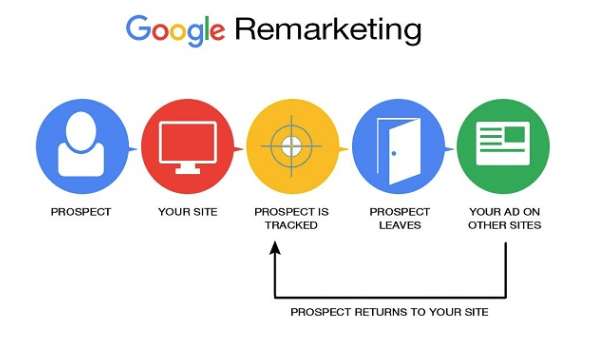
Re-marketing, also known as re-targeting, is defined as a type of online advertising that shows ads to people who have visited your website, or a specific web page, and may have exhibited a specific behavior (e.g., not converting into a site conversion goal). For example, let’s say you were browsing on Amazon but didn’t make a purchase. When you go to another website, you will see an ad for that product from Amazon. Re-marketing, using Google Ads and Facebook, is a great way to reach previous website visitors and make your digital marketing more successful.  It is a second chance to advertise, an opportunity to cross-sell, up-sell or nurture your audience with your content marketing efforts. Rather than having to rely on targeting customers that have filled out a form for an e-book, call, blog, or newsletter, you can re-target ones that have interacted with your site. You can engage with visitors even when they leave your website and work to convert them at their own pace.

Why Re-marketing?

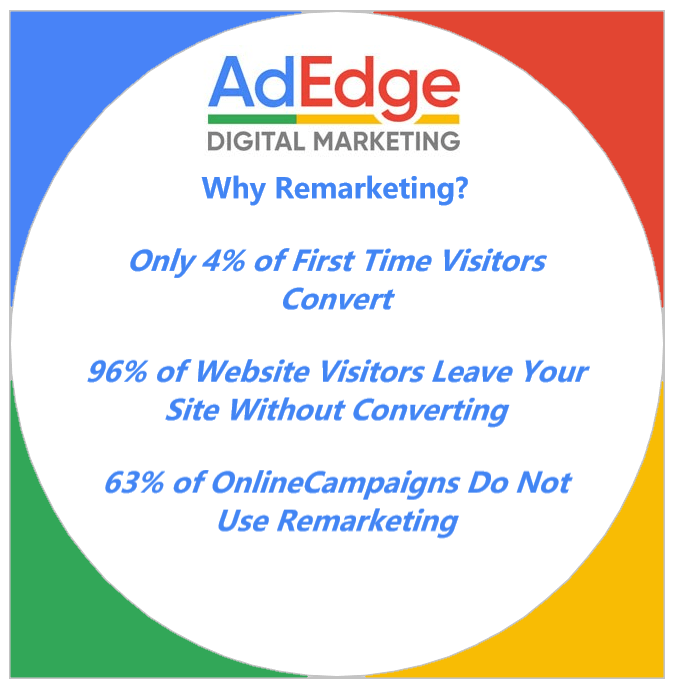
Studies show that, 96 percent of visitors that land on your website will not convert into a sale or new customer.   No matter how attractive or creative your ads, getting a  first time conversion is unlikely, happening about 4% of the time on average. Currently, most clients do not use re-marketing and approximately 63% digital marketing campaigns on Google and Facebook do not use re-marketing tactics.   This is a big opportunity to businesses to reach the 96% interested viewers who did not yet convert. When browsing the web from a desktop or a smartphone, it is easy to get distracted. So re-marketing is a great way to keep your brand front and center in the minds of your customers and potential customers. It has been proven that returning visitors have a higher chance of converting. This is because returning visitors recognize your brand and, with each subsequent interaction, their recall increases.

Types of Re-marketing?

Google

Google began re-marketing offering for display advertising in 2010, with Google Search following in 2013.  Google’s Display Network works with some of the most highly trafficked sites at a much more affordable price than working directly with the site.  Through Google Ads, you can re-target visitors with ads that show the products they viewed on your website. For the search network  you can also use something called re-marketing lists for search ads (RLSA). Basically, you can reach people searching for specific keyword terms who have previously visited your site.

Social media

Facebook launched custom audiences in 2012, its version of re-marketing. In re-targeting ads on Facebook, not only are you seeing a special offer with a clear call-to-action (CTA) – you also see how many of your friends “like” the fan page.. This is often called the herd or pack mentality – when people mimic the behaviors of those around them. This adds credibility to your brand, which can help boost conversion rates for people who are on the fence.  The average click-through rate (CTR) for Facebook display ads is 0.07% when the CTR for re-marketing ads is 0.7% – 10 times higher. Studies show that people are 70% more likely to convert with a re-marketing campaign than with an initial campaign.

Email

Using your current email list, it’s possible to show ads specifically to people on your email list.    The email mailing lists can be uploaded directly to Facebook and Google. But you can also use re-marketing to create audiences using email addresses you’ve collected from your current customers or through lead generation. Also, anyone who opens your email can be served a follow-up advertisement related to the email.

How it works?

The most common type of re-targeting is known as pixel-based re-targeting. This works by placing a piece of JavaScript on the browsers of visitors to your website.   This pixel is a snippet of code that will be able to track users for the campaign to serve ads when the time is right. After they leave your site and continue to surf the web, they will be served ads based on what they viewed on your website.    In some cases, initially you may find that re-marketing volume is actually small. Keep in mind as time goes on you can build up a larger list with historical data.  The typical 30-day window to build an audience could be too small to reach an audience.   It’s possible to go up to 180 days from the last time a user visited the website. The minimum list size in Google Ads is 1,000 users, based on your typical CTR (click rate) and CVR (cost per view)  you may need a higher threshold. For example, if you typically see a 5 percent CTR and a 2 percent CVR, 1,000 impressions will produce up to 50 clicks with the minimum list size.    

What should my message be for re-marketing ads?

A common assumption is that someone who did not convert may need an extra incentive in the form of repeated and/or more compelling messaging. Many users in their discovery phase are not only researching potential solutions but also confirming that the problem they are looking to solve is indeed the right problem to be solving. When setting up re-marketing, test both a sell message and a cross-sell or up-sell message. Give users more reasons to keep you in mind, particularly if your site offers products that are common supplements or complements. The sell message entails saying the same thing users heard before in a different way: with a more direct call to action and/or an exclusive, one-time offer. It is important to note that you must notify all visitors to your site that you will be using cookies, i.e., the Facebook pixel, to track them for advertising purposes.  This is typically done on a privacy policy page.

Conclusion

Re-targeting can seem overwhelming or confusing at first, especially with all these terms, platforms and information overload. In simple terms, It’s just like trying to bring window shoppers into a physical store. , It is the digital version of selling to a customer after you’ve already met and had a conversation with them. To learn more about re-marketing and how it can help your business you can contact us at 203-682-4585 or sign up for our our newsletter to receive monthly updates about the latest digital marketing tactics.


Voice Search Optimization

Voice Search Optimization

We’re sure you’ve heard the term “Voice Search” before but if not, you’ve come to the right place! So what is Voice Search, exactly? Google Voice Search aka Google Assistant is a feature that allows users to speak their question into a computer or mobile phone that is then translated into text which is then searched. Why get involved with voice search? Maybe you’ve had great success with traditional search ads and are hesitant to change but in Digital Marketing, early adapters almost always win the performance game. Naturally, the ability to search for the information you want by speaking instead of typing is far more convenient, and this trend is only likely to become more prevalent in the future. We’re here to show you how voice search is going to play a significant role in the future of search marketing and how you can adjust your strategy to make sure you still show up for voice searches.

Here are five tips to help you prepare:

1) Audit Your Current Content: Before moving forward with anything else, it’s important to evaluate your current strategy and see what has worked for you and hasn’t. Reviewing keywords that have brought success can help you build a separate voice search campaign with relevant long-tail keywords. Think about what you would say when searching for information on your phone. For local businesses, terms like “near me” or “closest” or “best” are all going to be used frequently, so optimizing your campaign to fit the mold is a great way to prepare.

2) Consider Position Zero: Position zero, also called featured snippets or answer boxes in Google, refers to the block of text at the very top of a search results page, and it answers your search query. Showing up here gives you a competitive advantage for two reasons, the first being that your name is the first thing the user sees on the screen, and part two is that you are establishing yourself as an expert on the topic which improves your reputation. So how can you appear in position zero for voice searches? A great way to start is by searching for questions pertaining to your business and seeing what doesn’t currently have a featured snippet answer in position zero. Then you can take your list and create relevant content on your website. You will have a better chance to earn that ranking before any competitors if you take the time to optimize your own page for these search query’s.

3) Consider Your Online Reputation: Just as with regular search, your online reputation is vital when it comes to voice search. Anyone looking for your products or services will always take online reviews and testimonials into consideration when deciding who to buy from or which service they want to use. Most businesses have a Google My Business listing to showcase reviews and improve their online reputation, anything less than 4 stars is a sign that there is an issue and you should do your best to resolve the issue with that customer or at a minimum, respond to it. If you think your online reputation could have been damaged in any way it may be a good idea to consult an online reputation management service to resolve the issue. You can schedule a free consultation  with AdEdge to discuss our online reputation building program to ensure your business has the online reputation it deserves.

4) Use Simple Language: Like we mentioned earlier, it’s important to incorporate terms on your website and in your ads that will pertain to voice search. Most people will be short and concise with their requests because they will be on the go when searching for the information they want. Unlike with regular search, it won’t be ideal to use long tail keywords as much as short phrases in order to optimize for voice search. Keep this in mind with any content you’ve already published, and when creating new content moving forward.

5) Create Relevant Content: Focusing on content that pertains to your ideal customer is what will give you an advantage with voice search. Instead of talking about broad topics, target your topics toward those specific individuals who’s business you are trying to earn. you will likely gain more traction this way when it comes to voice search and have a higher ranking on the search engine results page.

Takeaway: As voice search becomes more popular, it’s important to take a step back and evaluate your current efforts. Optimizing your content, and implementing best practices will ensure you have success with voice search and ensure your business continues to rank on Google’s SERP’s. If you have any questions about the new voice search trend, you can contact one of our digital marketing experts for a free consultation or visit AdEdge Digital Marketing for more information.